· Maya Colton
How long should you wear toe spacers? A coach's schedule
The most common mistake I see with toe spacers has nothing to do with the product and everything to do with the schedule. Someone unboxes a new pair, wears them for three hours on day one, wakes up with sore feet, and decides toe spacers do not work. Your toes have spent years pressed together in tapered shoes; they need a ramp, not a cliff. Here is the exact progression I give my coaching clients, along with the stop signals that matter more than any timer.
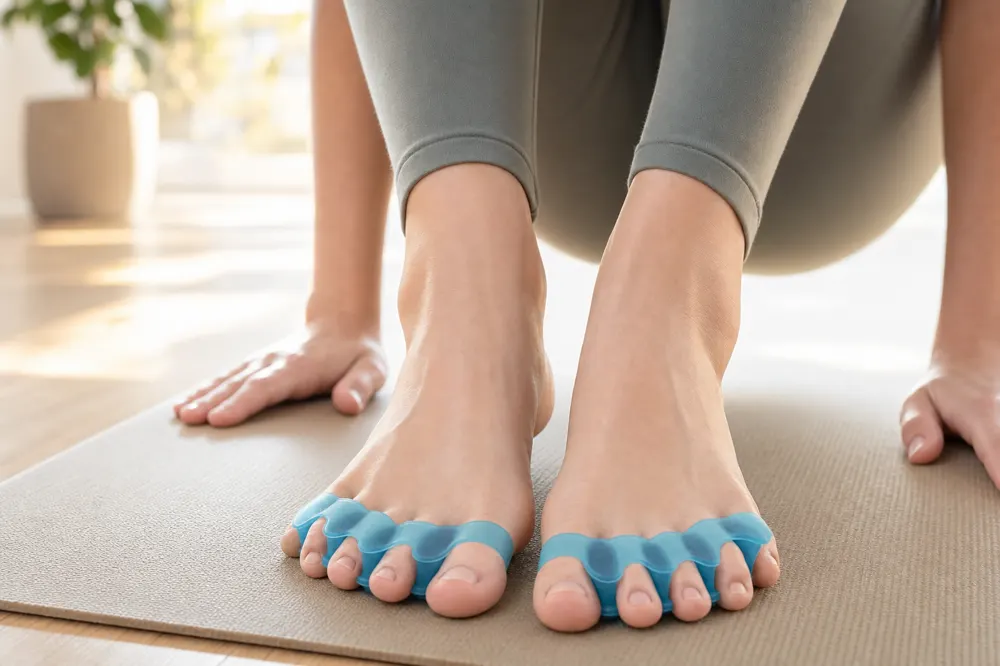
The week-by-week progression
Approach toe spacers the way you would approach a new stretching routine: small doses, repeated daily, increased only when the current dose feels easy. This is the schedule that has worked for the vast majority of people I have coached through it.
| Phase | Daily wear time | What it should feel like |
|---|---|---|
| Days 1-3 | 15 minutes | Gentle stretch, mild novelty, no pain |
| Days 4-7 | 20-30 minutes | Comfortable, you almost forget them |
| Week 2 | 30-60 minutes | Relaxing; feet feel decompressed after |
| Week 3 and beyond | 1-2 hours | A normal part of your evening |
Notice what is not on that table: all-day wear. A soft gel five-toe spacer like our $19.99 pair is a home and mat tool. If you want something you can wear inside shoes during the day, that is a different product and a different article; slim separator tubes worn under a sock in a wide toe box shoe are the right tool there, and even those I would build up gradually.
Stop signals: when to take them off immediately
Time targets are guidelines. Your body's signals are rules. Take your spacers off right away if you notice any of the following, regardless of how long you have been wearing them.
Pain. A gentle stretch between the toes is expected and fine. Sharp, aching, or burning pain is not. Pain means the stretch is beyond what your tissues are ready for today. Numbness or tingling. These are signs of compressed nerves or restricted circulation. Gel is soft, but if a spacer is jammed too deep between the toes, it can still press where it should not. Skin irritation. Redness that does not fade within a few minutes of removal, or any rubbing sensation, means you should shorten sessions and check the fit. Cold or discolored toes. Extremely rare with soft gel spacers, but an immediate stop signal every time.
None of these signals mean you failed or the product failed. They mean today's dose was too high. Drop back to the previous phase for a few days and rebuild. And to be clear about scope: toe spacers are comfort products, not medical devices. If you have persistent foot pain, see a podiatrist rather than trying to stretch your way through it.
Three routines that make the habit stick
The schedule only works if you actually follow it, so anchor your spacer time to something you already do every day. These are the three routines my clients keep longest.
The evening wind-down. Shoes off, spacers on, and wear them while you cook dinner or watch a show. This is the easiest habit because the trigger, taking your shoes off after work, happens daily without thinking. Nearly one in four adults aged 18 to 65 has some degree of hallux valgus according to Nix and colleagues (2010), and for that group especially, the end-of-day decompression is usually the moment spacers feel best.
The yoga and mobility pairing. Spacers during yoga or a stretching session add a layer of foot awareness that most people have never felt. Balance poses become honest: with your toes spread, you feel exactly how much your feet participate in stability. Start with floor-based practice before standing flows, since your balance will feel different at first.
The post-run reset. After a run, while your feet are warm and pliable, is my personal favorite window. I slide spacers on during my cooldown stretches and leave them in through my shower-and-snack routine. Warm tissue takes to the stretch more readily, and it turns spacer time into a reward rather than a chore. Several runners in our buyer reviews describe the same ritual.
Can you wear them too long?
Yes, mostly in the first weeks. Overdoing early sessions is the number one cause of soreness and abandoned pairs. Past the adaptation phase, wearing soft spacers for a long evening is fine for most people if all the stop signals stay quiet. Nighttime is its own question with its own precautions; I wrote a separate guide on sleeping in toe spacers, and the short version is: only after weeks of comfortable daytime use, and never with a tight fit.
Which spacer for which schedule?
For the routines above, the gel five-toe spacers at $19.99 are the default: soft SEBS-style gel, all four gaps at once, ideal for sessions of 15 minutes to 2 hours. If one particular toe is your whole problem, targeted separator tubes make more sense: $19.99 for a 3-pack or $24.99 for a 6-pack, in two ring sizes per our 2026 measurements (S: 3 x 1.5 x 2 cm, L: 3.2 x 1.8 x 2.2 cm). The Complete Toe Comfort Kit at $39.99 instead of $44.98 bundles both so you can match the tool to the moment. Whichever you choose, it ships with a 30-day money-back guarantee and tracked delivery, and you can always email us for sizing help. For everything else we have learned from testing, our guides page and methodology are open to read.
Toe spacers are comfort products, not medical devices. If you have persistent foot pain, see a podiatrist.